

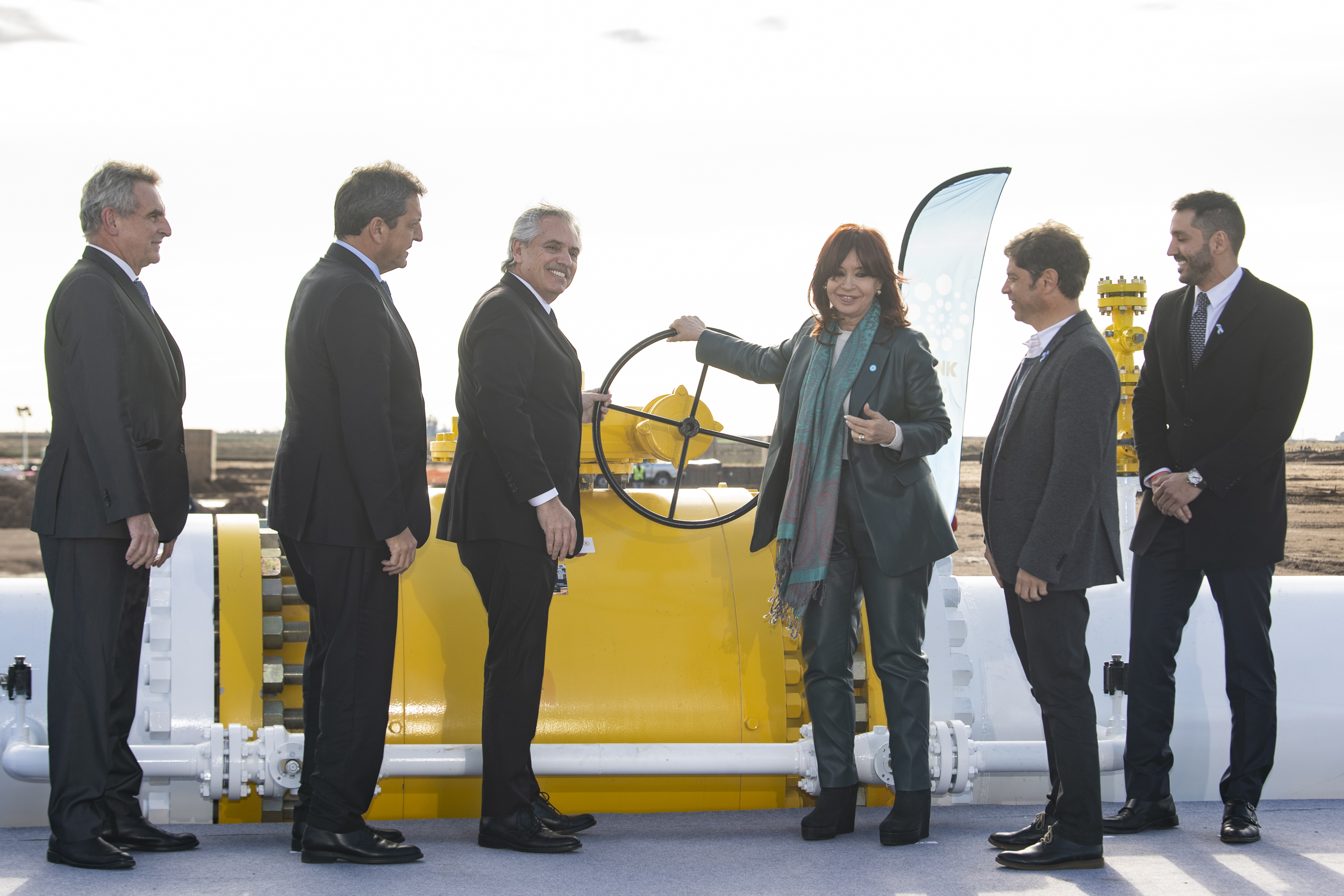
The Nation's president Alberto Fernandez, the vice-president Cristina Fernández de Kirchner and the minister of Economy Sergio Massa, led from Salliqueló, Buenos Aires province, the act of inauguration of the Pipeline, President Néstor Kirchner, the work which transforms the energy matrix and productive for our country.
Also participated the governors of the province of Buenos Aires, Axel Kicillof, Neuquén, Omar Gutiérrez and the elected Rolando Figueroa (by videoconference), and Pampa, Sergio Ziliotto, in addition to the Interior minister Eduardo Wado Of Peter, the deputy national Maximum Kirchner, the president of Energy Argentina Augustine Gerez, among other officials, national and provincial, representatives of business and union leaders, among others.
President Alberto Fernandez stressed that “a July 9, here in the heart of the province of Buenos Aires, in some way, we are starting to declare energy independence of Argentina”, and contrasted the achievement with “the government that have preceded us, that he tried several times and was unable to do so” because “the Monetary Fund prevented him from doing so, or because when he wanted to do it without funding from the State, through the participation of public, private, what he invented was a formidable business.”
In turn, the vice-president Cristina Fernández de Kirchner said that the completion of the gas Pipeline was not “magic” but the result of a public policy that crown “the recovery of our oil flag in 2012”, and because “while that between 2003 and 2015 were built 3.211 kilometers of gas pipelines”, between 2016 and 2019, “only built 53 miles”, and there was a “hollowing total of YPF”. On the play, which was inaugurated on Sunday, the former President stressed that in addition to seeking to export the resource “we want oil and gas for our industry to be more competitive, and gas for households argentines, because it is not fair that if we have the second gas reserves of the world are not conventional, and the fourth in oil, we want to charge things to the price of the dollar”.
Sergio Massa, minister of Economy, said that “compared to those who argue that Argentina is a country of failure, it appears the pride of being an argentine, and to know that we have with which to build the future of our nation.” And thanked “each one of the actors that started this way”, among which he mentioned to the Vice president for the recovery of YPF, the President for the decision to continue the Pipeline, the companies involved in the work, and the workers who made it possible, and to the governors, to the teams of the ministry of Energy and ENARSA, and the legislators who passed the supportive contribution of large fortunes.
For his part, the president of Energy Argentina, Augustine Gerez, stated that “in nine months we have managed to accomplish a goal that I think we have to take pride to all, regardless of political color,” and added “this is a resounding success for the whole of the society and demonstrates a path to follow. Beyond the benefits that you can leave the pipeline, I think that traces a line of behavior with respect to the State in conjunction with the private sector so that together we can achieve the goals that end up favoring all sectors”.
On June 20, they concluded, the works, and enabled the plant EMED Tratayén, Neuquén, and for the first 29 km, while in the subsequent days were putting into operation new sections until you reach the km 285 of the trace.
Saturday, July 8, opened the valve of the km 285 which enabled to km 570, so that the gas can flow up to Salliqueló and continue until you reach the full population of 573 km of the gas pipeline.
Enabling partial and progressive, which is standard procedure in this type of operations, aims to ensure the filling homogeneous of the pipeline with natural gas displacing completely the air and involves phases of sweeping and pressure of the pipes. In addition, it allows you to test the operation of the measurement systems and regulation of plants.
The construction of the Pipeline, President Néstor Kirchner began after the signing of contracts in August 2022, when works began on the movement of soil, transfer of equipment and opening track, which is the “way” to where it is placed in the gas pipeline. After the first few welds in the trace, it is advanced with an average of 5 km per day counting the three fronts of work. So it was that they tended more of 47.700 pipe 12 meters long and 36 inches in diameter, in the 573 kilometers of extension of the GPNK between Tratayén and Salliqueló, crossing the provinces of Neuquén, Río Negro, La Pampa and Buenos Aires.
The Pipeline, as President Néstor Kirchner is a work of critical and historical, that will allow to increase the production of Cow's Dead (the second book of non-conventional gas in the world), expand the transport capacity of gas and get to the centers of consumption, allowing for an annual saving of 4,200 billion dollars per year in replacement of fuel imports.
Also participated in the act, the deputy general manager of Energy Argentina, Gaston Leydet, the members of the company's board of directors Mariano Barrera, Mario Metaza, Victor Bronstein and Oscar Cretini, the chief of Contractual Control, William Flanigan, the manager of co-Ordination, Execution and Construction of gas Pipelines, Andrés Crespo, the Manager of Supply, Susana Moya, and the director of Administration and Finance, Wild Bisquert, as well as Energy workers in Argentina who worked in the inspection of the work of the GPNK.


